COURSE PREVIEW · GOLF · 2026-07-21

The Putter Wins in Minnesota — Here's Who Should Worry

TPC Twin Cities is a scoring fest where the putter separates contenders from also-rans. The model's done the work on who fits, who's overpriced, and where the real leverage hides in a 139-man field.

Arcline Analytics
00 · OVERVIEW

Every summer the Tour rolls into the Twin Cities and plays a golf tournament that, if we're being honest, is less about survival than it is about accumulation. TPC Twin Cities is not trying to break you. It's offering itself up — a field scoring average of 69.5 tells you that — and the question becomes not who hangs on but who runs. There are no real hiding spots here, no survival-of-the-fittest rough that protects par like a bouncer. The course is parkland, playable, and by Sunday afternoon somebody is going to be double digits under and hoisting hardware.

That's the week. That's the assignment. And the model's read is pretty clear on how you win it: you've got to make putts. Not some putts. A lot of putts. Because when the field is averaging well under par and the fairways are generous enough that most professionals find them at a reasonable clip, the separation has to come from somewhere — and at TPC Twin Cities, it comes on the greens, in the short game, and, yes, off the tee in a way that matters more than the course's forgiving reputation might suggest.

For DFS players, this is a leverage week. The field is 139 deep, Scheffler is going to be everywhere, and the difference between a good lineup and a great one is probably going to be found somewhere below the $8,000 salary tier. We'll get there. First, let's understand the ground we're standing on.
01 · THE COURSE

TPC Twin Cities sits just northwest of Minneapolis in Blaine, Minnesota — a parkland track built in the TPC mold, which means it was designed with spectators and television in mind as much as pure golf. Par 71, with four par 3s, eleven par 4s, and three par 5s. The par 5s are where the birdie trains get their fuel; the par 4s are where the week is actually decided.

The course plays through mature trees with enough width off the tee that distance is a weapon but accuracy isn't a desperate requirement. That makes it sound easy. In a sense, the bones of the layout are forgiving. But forgiving bones don't win tournaments — a hot putter does. The greens here reward precision approach play, and once you're on the putting surfaces, the complexes have enough character to separate the great putters from the merely adequate ones.

Weather in the Twin Cities in late July can run from perfect to legitimately windy, which is the one wildcard that can shift the week's character. On a calm week you're looking at low-scoring, fast-moving conditions where the leaderboard fills up quickly. The model's course profile reflects the version of this track the numbers actually reward — and the most important skill set, as we'll explain, involves what happens once the ball stops rolling.

02 · WHAT THE MODEL REWARDS

Here's how the model weights the skill sets at TPC Twin Cities this week:

What the model weights at this course (0–1)
Putting
0.9
Approach
0.8
Around green
0.7
Off the tee
0.6

Putting is the engine — it carries the heaviest weighting of any skill category at this venue, and it's not particularly close. That tracks with what you see when you study the historical leaderboards here: the guys who go low on the weekend are almost always the ones who get hot with the flat stick. Around-the-green work is next, which makes intuitive sense — in a scoring environment where birdies are expected, the short-game misses that cost you strokes become magnified. You can't afford to leak shots scrambling when the rest of the field is making everything.

Approach play matters, as it always does on a parkland track where iron precision sets up the birdie looks that fuel low rounds. Off-the-tee comes in at a lower weighting, but don't read that as irrelevant — the model is telling you that length isn't the primary differentiator here, not that fairways don't matter. Guys who drive it into the trees still pay a price; they just don't pay it quite as steeply as they would at a venue with truly penal rough.

The takeaway for roster construction: prioritize putting and short-game track records before you worry about who's bombing it 320 yards. A great putter with a slightly lower ceiling often outperforms a longer hitter with a cold putter on a course that gives up this many birdie opportunities.

03 · THE WINNER'S PROFILE

The guy hoisting the trophy Sunday evening is, in all likelihood, someone who did a few things exceptionally well over 72 holes. Let's sketch him out.

He made putts from everywhere. Not just the tap-ins — the 12-footers for birdie, the 20-footers that could easily have been pars. In a field scoring environment sitting at 69.5, the winner is probably 20-under or better, which means he made more than his share of the putts that the leaderboard demanded.

He gave himself looks. The approach play was precise enough that he wasn't constantly manufacturing from awkward distances. TPC Twin Cities rewards the player who finds the right quadrant of the green consistently — not just the green itself, but the favorable pin position side. Iron accuracy to quality areas of the putting surface is what separates a 15-under week from a 22-under week at this venue.

He played the par 5s well. Three of them on a par-71 layout — those holes need to be birdied, ideally with a realistic eagle look mixed in. A player who goes 3-under or better on the par 5s across four rounds has already separated himself from a meaningful portion of the field.

And he probably didn't lose it off the tee. Not because this course eats drivers alive, but because the scoring environment is unforgiving of avoidable bogeys. When birdies are the expectation, a bogey feels like a double. The winner found enough fairways to keep his approaches manageable and let the rest of his game do the work.

04 · NAMES THAT FIT

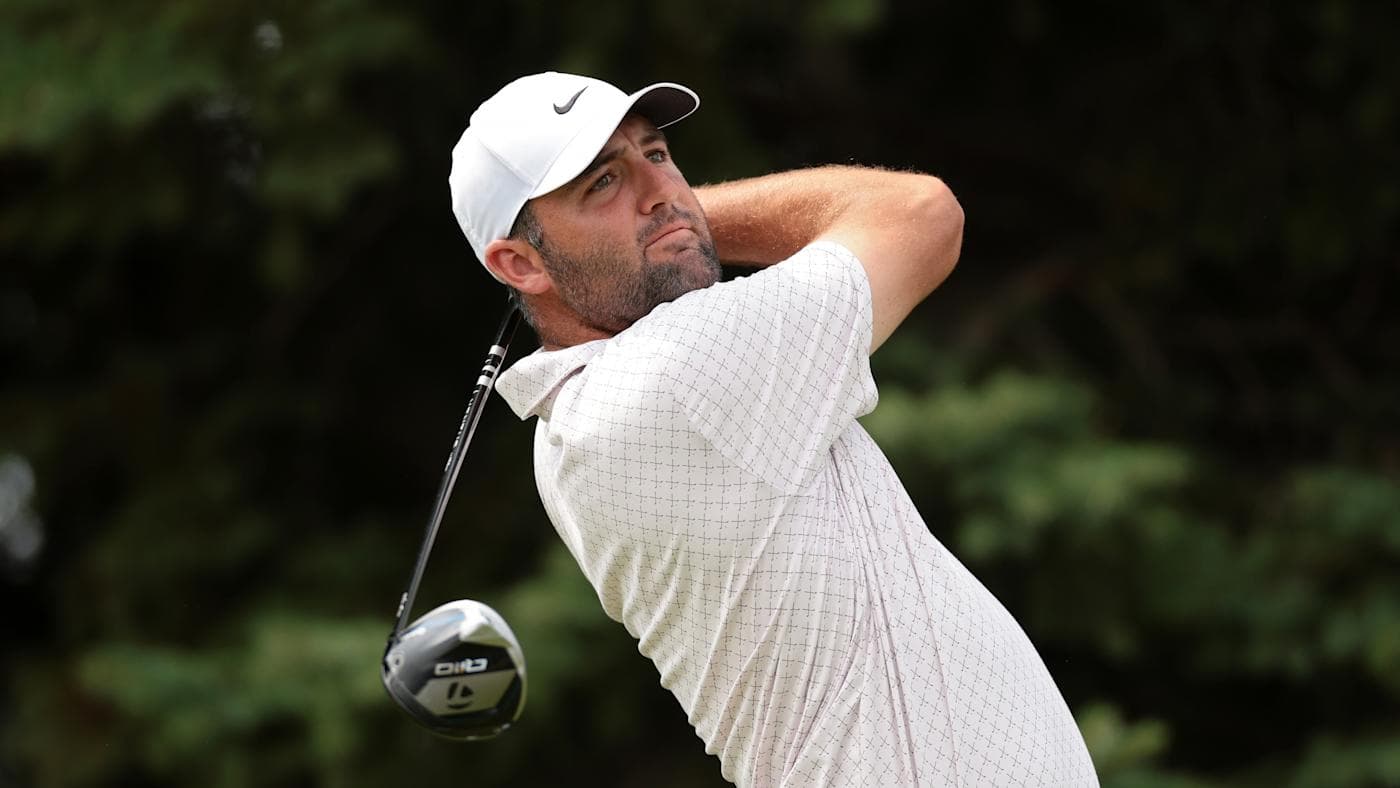
Let's start with the elephant in the room. Scottie Scheffler at $14,900 is going to be in 45% of lineups, and the model projects him at 109.8 with a ceiling of 137.5. His course fit grades out at a B — not a natural match, but Scheffler's floor is so high and his ceiling so wide that the B-fit almost doesn't matter. The question isn't whether he's good; it's whether 45% ownership is a position you want to be in. At a leverage score of 1.9, he's essentially a market-neutral play. You won't win a tournament by being right about Scheffler if everyone else is also right about Scheffler. He's a fine anchor. He is not where the week gets won in DFS.

For the players where the model actually gets interesting, look here:

Best course-fit value (model)
PlayerSalaryProjOwnLevFit
Ben Kohles$7.3K62.57.4%3.5xA
Brian Harman$7.4K62.18.1%3.4xA
Andrew Putnam$7.0K59.23.1%7.2xA
Zac Blair$6.9K58.02.5%8xA
Emiliano Grillo$7.3K56.85.6%3.6xA
Lee Hodges$7.2K56.54%4.8xA
Takumi Kanaya$6.7K54.31.3%12.5xA
Matt Kuchar$7.0K54.22.1%7.2xA

Ben Kohles and Brian Harman are the two names I keep coming back to from the best-fit group. Both grade out at A for course fit — the highest grade in the model — and both sit in the $7,300–$7,400 range with leverage scores above 3. Kohles projects at 62.5 with a ceiling of 99.5 at just 7.4% ownership. Harman, a notoriously precise iron player and one of the better putters on Tour, checks in at 62.1 projected with the same 99.5 ceiling at 8.1% owned. On a course where the putter and the short game do the most damage, Harman's profile is quietly compelling.

Andrew Putnam is the low-ownership dart worth knowing about — $7,000, A-fit, 3.1% projected ownership, and a leverage score of 7.2. The projection of 59.2 is modest, but at that price and that ownership, the ceiling of 96.5 starts to matter in a different way. Zac Blair is in similar territory at $6,900 — 2.5% owned, a leverage score of 8.0, and an A course fit. These are not star turns. They're the kind of plays that win you a contest when the week breaks right.

From the top-projected tier, Tom Kim at $9,300 is the one the model gives a B+ fit — the best fit grade among the higher-priced options. At 19.1% projected ownership and a ceiling of 106.5, he's chalk but not overwhelmingly so. Corey Conners at $8,700 is the B+ fit in the mid-tier, with a leverage score of 2.4 at 14.4% ownership — the model likes his iron game profile for what this course demands. Doug Ghim at $9,000 gets the lone A-fit grade among the top-projected names, which is worth noting. He's 15.3% owned with a ceiling of 104 — not exactly a contrarian play, but the course fit is as good as it gets in that salary range.

05 · THE BOTTOM LINE

Here's what this week is, simply: a scoring contest on a forgiving parkland track where the putter is king, the short game is queen, and the par 5s are the prime ministers. The model's weights confirm what watching this tournament over the years suggests — the leaderboard is going to be populated by guys who made everything inside 15 feet and didn't waste shots scrambling.

A word of genuine honesty about the edges: the outright betting market came back empty from the model this week. No plays cleared the bar. That's not a failure — that's the model doing its job. When there's no edge, we say so. Putting cash on a slate where the numbers don't give you an advantage isn't bold; it's expensive. The sharper move, if you're playing DFS, is to focus the construction work on the leverage and fit grades in the value tier rather than forcing betting exposure that the model doesn't support.

The target scores for cash are 391 points, top-10 requires 480, winning needs 547, and optimal is 697. Those numbers tell you this is a high-scoring, spread-out slate. You need upside. You need guys who can get hot. And you probably need at least one player somewhere in the $6,900–$7,400 range who goes low on the weekend while nobody's watching.

Minnesota in July. Good weather, good scoring, and somewhere in a 139-man field, a guy is going to catch fire on the greens and run away from everybody. The model's given you the profile. The homework is done. Now we watch the golf.