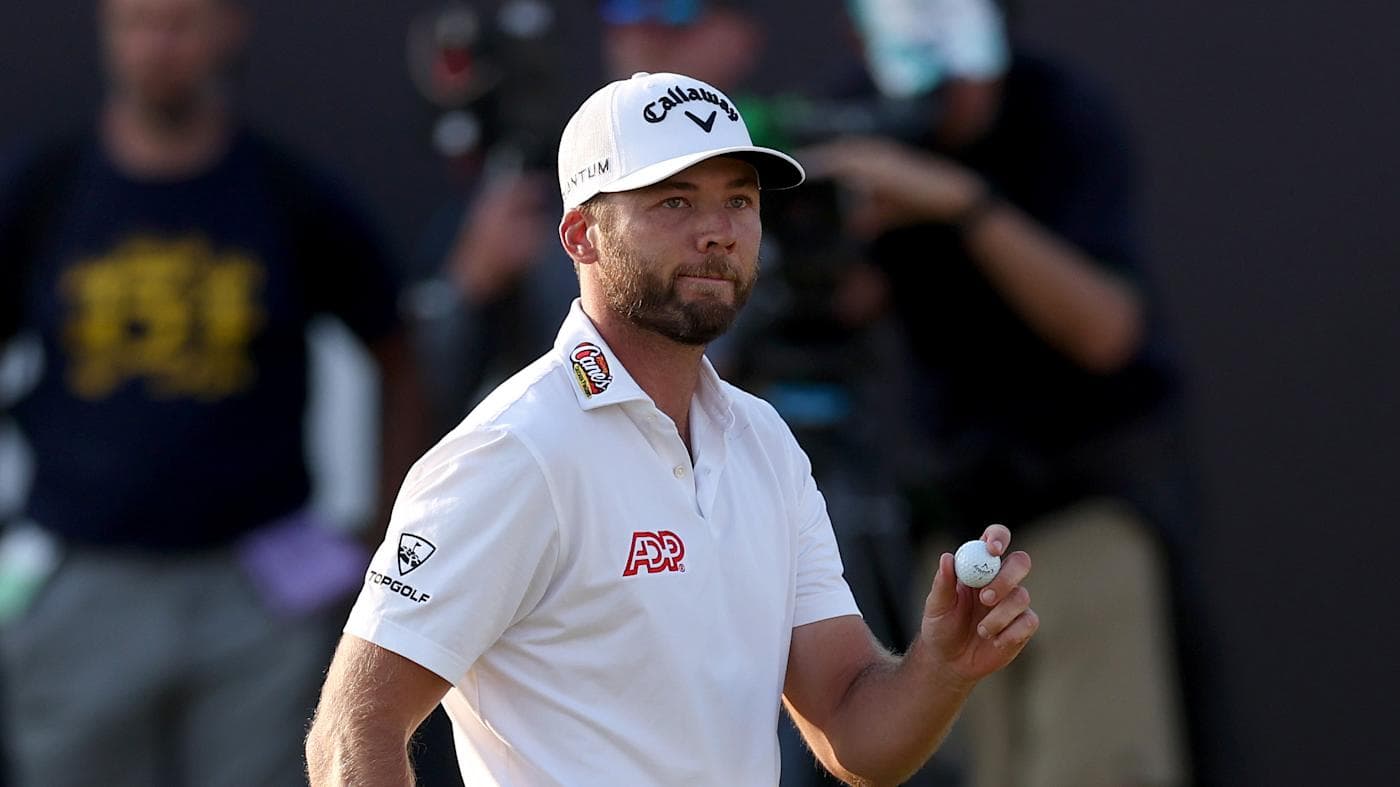
Sam Burns. Photo: PGA Tour. Credit only. Taken down on complaint..
COURSE PREVIEW
Birkdale Is Back, and the Model Says the Course Wins
Royal Birkdale is the most demanding links test in the rotation — a place that exposes pretenders and rewards a very specific kind of ball-striker. Here's what the course actually asks for, who fits it, and where the model finds its edges.
By Arcline Analytics9 min read
OVERVIEW
There is no golf week like Open Championship week. Not because of the history, the pomp, or the fact that the Claret Jug is the most beautiful trophy in the sport — though all of that is true. It's because the Open is the one major where the golf course is genuinely the third competitor in the field, and this year the venue makes that truer than ever.
Royal Birkdale is back. It last hosted in 2017, when Jordan Spieth staged one of the great final-round scrambles in major championship history and the scorecards looked nothing like anyone expected. That is, historically, what Birkdale does. It sits among the sandhills of the Lancashire coast, and it has a way of sorting the field with a quiet, almost impersonal efficiency. It doesn't punish drama. It punishes imprecision.
The field is 110 players. The target score to cash in DFS is 306 points; a top-10 finish needs 379; the optimal lineup projects to 566. Those numbers frame the week for you — the spread between cash and optimal is enormous, which means roster construction is everything. Getting the course profile right is where you start.
THE COURSE
Royal Birkdale sits on the Southport coast and it plays differently from every other links venue on the Open rota. Where St Andrews sprawls flat and exposes you to the sky, and Carnoustie grinds you down with sheer hostility, Birkdale is routed through valleys between enormous sand dunes that actually provide some shelter — and then punishes you the moment you drift into them. The rough in those dunes is not rough in the American sense. It is a verdict.
The fairways are wider than they look from the tee, but they only feel wide if you're hitting it straight. The approach angles are demanding, and the greens — firm, fast, subtly contoured — reward players who can control their trajectory and spin the ball from tight lies. This is not a venue that rewards bombing-and-gouging. The premium is on approach play from the correct positions, and on a short game that functions under wind pressure.
Wind is not a variable at Birkdale — it is the course. Historically, the wind shifts and the leaderboard reshuffles. Players who can flight the ball — keep it under the wind, work it both ways, trust a low punch from 170 yards — have a structural advantage over players whose A-game requires calm air and fluffy lies. That distinction matters more here than anywhere else on tour.
The greens complex rewards precision with the irons. Approaches from the correct angle open up pin positions that are simply not accessible from the wrong side of the fairway. That means driving accuracy isn't just about avoiding the dunes — it's about setting up the right angle into greens that do not offer a lot of forgiveness from the wrong quadrant.
WHAT THE MODEL REWARDS
The model's course profile for Birkdale, reflected in the fit grades across the field, tells a clear story. This is an approach-play and ball-striking course first. Scrambling and short-game competence matter, but they matter in support of a game built on iron precision and trajectory control — not as a substitute for it. Players who win here tend to be players who don't need to scramble, because they're hitting enough greens from the right places that the short game only has to be solid, not heroic.
The fit grades confirm the model's skepticism of pure power players whose games depend on soft conditions or wide-open angles. A B- or C grade on a player at the top of the board isn't a disqualification — the best players in the world can overcome course fit — but it does mean the edge goes somewhere else. The A grades in this field cluster at the mid-tier of the salary range, and that's where the construction interest lives.
THE WINNER'S PROFILE
The player who lifts the Claret Jug at Birkdale this week will share most of these traits. They will be a naturally lower-ball-flight iron player — someone whose stock shot moves under pressure rather than ballooning into the wind. They will drive it straight enough to consistently access the correct angles into greens. They will putt well on firm, fast surfaces where the pace is more consequential than the read.
They will also be someone who has either played links golf extensively or whose game travels — meaning their shot-making vocabulary includes knockdowns, bump-and-runs, and the willingness to take what the course offers rather than imposing an Augusta-style precision game onto a surface that will reject it. The Open has a history of crowning players who adapt. It quietly eliminates players who don't.
One more thing: they'll probably make the cut comfortably. The projected cut line from the model sits in the 75–88 range depending on conditions, and the winner's profile is a player who never really flirts with the cut — someone who grinds out a solid 69 or 70 in the worst conditions of the week and then takes advantage when the weather breaks. Consistency across four rounds under varying conditions is a Birkdale requirement. Four identical rounds of 68 beats one 62 and one 76 every time.
NAMES THAT FIT
Start with the top of the board. Scottie Scheffler is the number-one projected player at 90.2 points with a ceiling of 129.1 and 31.3% projected ownership — he is the chalk anchor, and at a B- course fit, the model is slightly cooler on him than the field is. That's not a reason to fade him in cash, but it's a reason to be thoughtful about how much of your DFS equity rides on him when ownership is that high and the fit grade isn't elite.
Tommy Fleetwood is the most interesting name at the top. B+ fit, 81.7 projected points, 116.5 ceiling, and 30.8% ownership — similar chalk volume to Scheffler, but the course-fit grade is meaningfully better. Fleetwood grew up playing links golf on this coast. He's a Southport native. If there's a home-crowd storyline at this Open, it runs straight through him. The model likes that, and so does anyone who's watched him compete in this event.
Matt Fitzpatrick comes in at B fit, 80.0 projected, 115.1 ceiling, 30.7% ownership. Fitzpatrick is a precision iron player whose game is almost purpose-built for this type of course. He's chalk-heavy, but the fit grade justifies the ownership in a way that a few of his peers at this salary tier don't.
The place where the model's edge is sharpest, though, is in the mid-tier value plays with A course-fit grades. Those players don't project as high as Scheffler or McIlroy, but they fit the course better than most of the chalk, and they're priced in a range that creates real lineup construction flexibility.
Best course-fit value (model)
Player
Salary
Proj
Own
Lev
Fit
Russell Henley
$7.7K
67.1
11.6%
3x
A
Aaron Rai
$7.1K
65.6
10%
3.1x
A
Alex Noren
$6.4K
60.4
3.1%
7.3x
A
Brian Harman
$6.6K
57.7
4.2%
4.7x
A
John Parry
$5.8K
53.1
0.6%
18.4x
A
Andy Sullivan
$5.5K
49.0
0.3%
29.2x
A
Bernd Wiesberger
$5.8K
48.3
0.6%
11x
A
Shaun Norris
$5.5K
44.2
0.2%
21.1x
A
Russell Henley grades A at $7,700 with a 67.1 projection and a 105 ceiling — 11.6% ownership means you can build around him without being the field. Aaron Rai is the most intriguing name on the board: A fit, $7,100, 65.6 projected, 104 ceiling, 10% ownership. Rai is a European Tour stalwart with real links pedigree and a ball-striking game that travels well to this type of venue. The model loves the fit. The price is right. The ownership is light enough to matter.
Alex Noren is the most extreme value on the board — A fit, $6,400, 7.3 leverage, 3.1% ownership. His ceiling of 97.0 won't win a DFS tournament on its own, but in a week where course fit grades drive the narrative, a player with an A grade at under $6,500 is a structural advantage in any lineup that needs salary relief to load up elsewhere.
Brian Harman — the 2023 Open champion — grades A at $6,600. The man knows how to win this tournament. His projection is modest at 57.7, his ceiling is 96, and his ownership is 4.2%. You are essentially getting the defending-caliber winner profile at a price that assumes he's irrelevant. The model isn't certain he is.
On the betting side, the model surfaces no outright edges this week — the book prices are reasonably efficient at the top. The placement edges worth noting: Si Woo Kim shows a model probability of 38% to finish top-20 against a book-implied 31.3% at +250 — 6.7 percentage points of edge. Justin Thomas and Patrick Cantlay each show roughly 5.7 points of edge at +275 for a top-20 finish. These are the edges the model is comfortable flagging. They're not overwhelming, but they're real.
THE BOTTOM LINE
Here is what this week comes down to: Royal Birkdale is a course that rewards a specific kind of game — precise iron play, trajectory control, links adaptability — and the model's fit grades tell you that the highest-owned players in the field are not the best fits for that profile. That gap is where the construction edge lives.
Cash lineups can lean on the chalk; Scheffler, Fleetwood, and Fitzpatrick are high-owned for reasons that are legitimate. But the tournaments are won with the A-grade value plays — Henley, Rai, Noren, Harman — who fit this course profile and come at prices that open up roster flexibility without sacrificing quality.
The Open Championship is the hardest week in golf to project. Wind, weather, and the sheer idiosyncrasy of links golf mean the model is working with more uncertainty than any other major. What it can do is tell you which players' games translate to this surface and which ones don't — and this year, at Birkdale, that information is as actionable as it gets.
The course is the story this week. It always is when the Open comes here.
This story reflects the information and prices available at the publication time shown above.