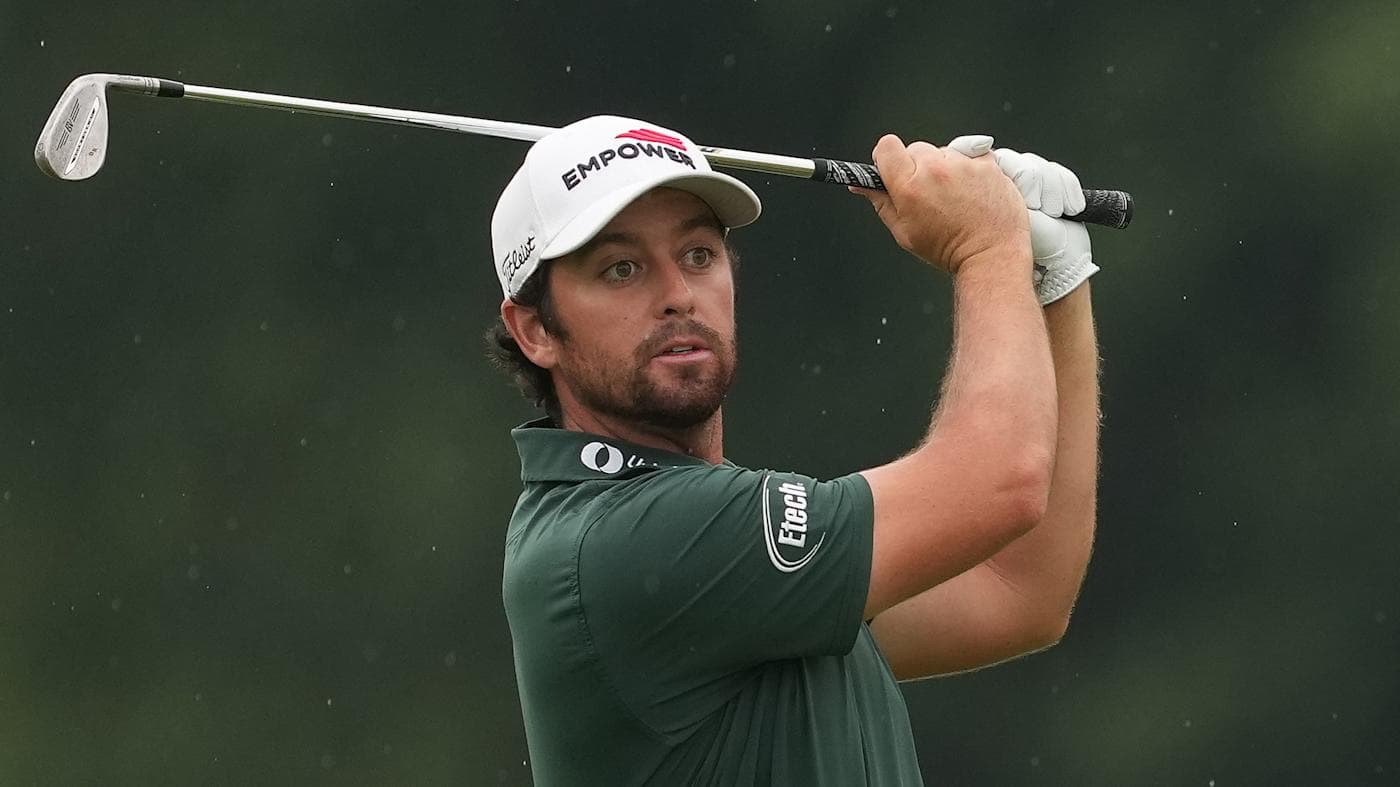
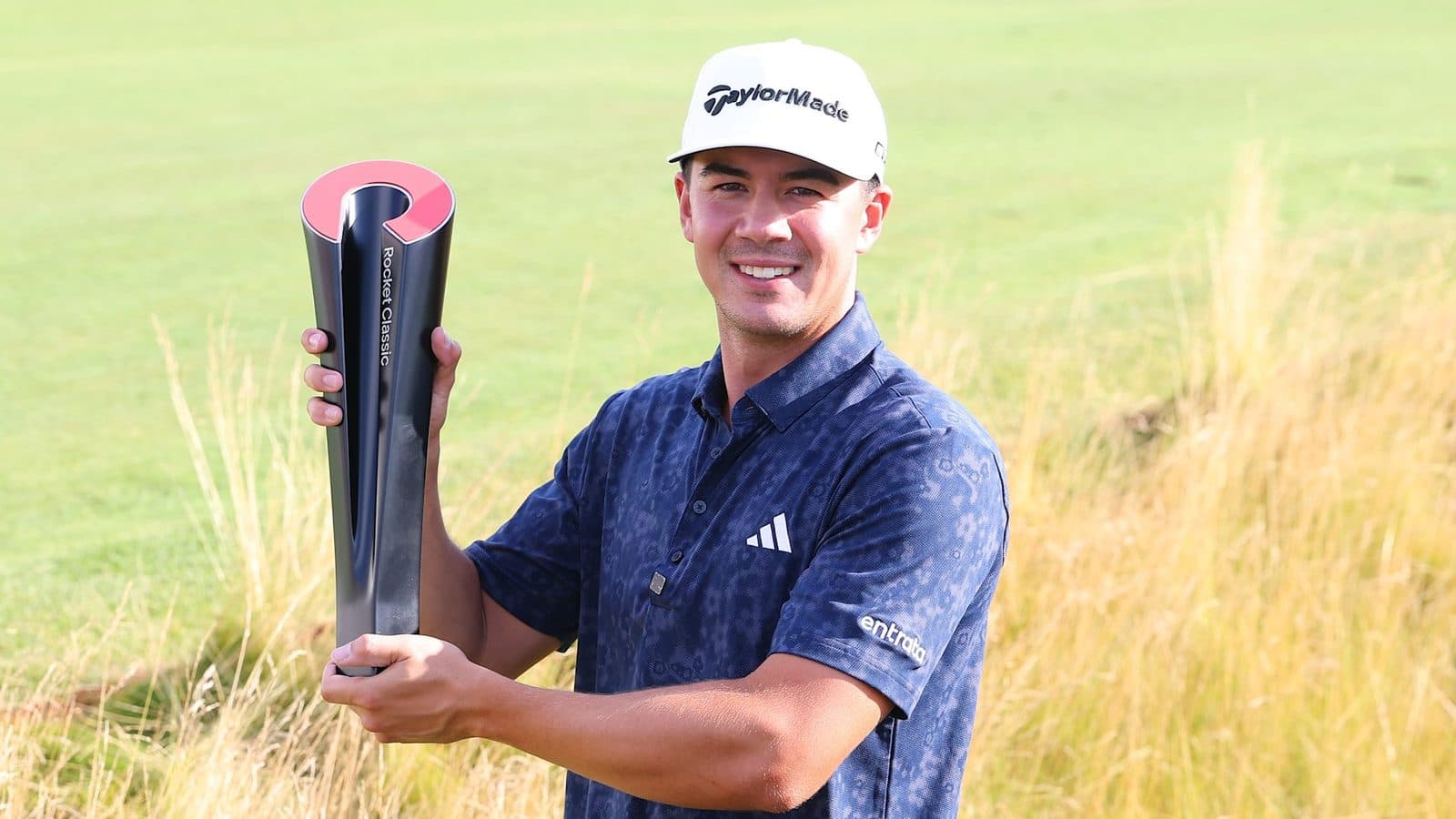
Davis Riley. Photo: PGA Tour. Credit only. Taken down on complaint..
COURSE PREVIEW
Detroit's a Putter's Paradise — and the Model Has a Name
Detroit Golf Club plays short, scores low, and rewards the guy who can make everything inside 15 feet. The model has strong opinions about who fits, where the books are soft, and which course-fit values nobody's rostering.
By Arcline Analytics8 min read
OVERVIEW
There's a version of the PGA Tour schedule that gets talked about constantly — the majors, the elevated events, the ones that feel like they carry the weight of the whole sport. And then there's a week like this one, where 139 guys show up to a classic old course in the Midwest, the scoring gets low in a hurry, and somebody nobody's been talking about all season shoots 25-under and cashes a check that changes their year. The Rocket Classic at Detroit Golf Club is that week.
It's not a sleepy week, though. Not for the people who pay attention. The field has real names — Cameron Young, Xander Schauffele, Patrick Cantlay — and the course has a real personality. It just happens to be a personality that doesn't show up on a highlight reel. It shows up on a Sunday afternoon when the guy who's been making every five-footer all week walks up 18 with a two-shot lead and doesn't blink.
The model's average projected score for the field is 69 — one under the new par-70 card, every round. This place gives up birdies. The question, as always, is who takes them, and who the books haven't quite priced right.
THE COURSE
Detroit Golf Club shows up this week with a $16 million restoration and a brand-new card: par 70, down from 72 — four par-3s, twelve par-4s, and just two par-5s now (Nos. 4 and 14), with holes 7 and 17 stretched into long par-4s. Every green has been restored to Donald Ross's original shapes. The old layout's field scoring average of 69 tells you how this place played before the renovation — guys went low here routinely, and you needed to go low to win. How the new bunkering and restored greens change that math is the week's open question.
This is an old, tree-lined classic. The kind of course where the architecture keeps the ball in play more than the yardage does, and where precision off the tee matters more than distance. Detroit Golf Club was designed to reward the player who thinks his way around rather than overpowers it. That has real implications for who wins here.
The scoring environment means there's no hiding on a bad ball-striking week — you still have to hit it close enough to make the putts. But the premium the course places on the short game and putting is significant. When the field is averaging 69, the separation between the guy who finishes T12 and the guy who wins is almost entirely made on the greens.
WHAT THE MODEL REWARDS
The model's course weights for Detroit Golf Club tell a pretty clear story. Putting is the single most important skill this week, weighted at 0.9 out of a possible 1.0. Around-the-green work is next at 0.7. Approach play matters at 0.8, and off-the-tee is the quietest piece of the puzzle at just 0.4. You could simplify the whole framework to this: make putts, get up-and-down when you miss, hit it close enough to give yourself looks, and don't worry too much about whether you're the longest hitter in the field.
What the model weights at this course (0–1)
Putting
0.9
Approach
0.8
Around green
0.7
Off the tee
0.4
That 0.4 OTT weight is notable. It's low enough that a shorter hitter with an elite short game is genuinely competitive here — maybe more competitive than his world ranking suggests. And it's low enough that a bomber who's been streaky on the greens is a real fade candidate, regardless of the name on the back of the card. Course fit matters this week, and the model's fit grades reflect it.
THE WINNER'S PROFILE
If you built the ideal Rocket Classic winner from scratch, you'd start with someone who's been one of the better putters on Tour recently — not just good, actually elite. You'd want solid approach play, the kind that finds the middle of greens consistently rather than relying on hero shots. You'd want a decent scrambling percentage, because even in soft-scoring environments, pars get made the hard way sometimes. And you'd want someone whose game doesn't rely on length to create separation.
The target score to win outright is 566 points in the model's DFS framework, which translates roughly to a performance in the mid-20s-under range for the tournament. That's what it takes to hoist the trophy in Detroit. Getting there requires four clean rounds, no blowup holes, and an absolute heater on the putting surfaces at least twice during the week.
One more thing: this course and this week historically favor players who are comfortable being in contention. The tree-lined layout creates a bit of pressure — you can't just grip it and rip it your way out of trouble — so the player who wins here tends to have the mental makeup to grind it out when the back nine Sunday gets tight. Course fit grades of A and B+ in the model are your signal that someone checks these boxes.
NAMES THAT FIT
The top of the model's projected leaderboard is led by Cameron Young at 83.2 projected points with a ceiling of 118.5 — he's the chalk play and the highest-owned name in the field at 26.7%. His B fit grade is solid without being exceptional; the model likes him but isn't in love with the course match. If he wins, most DFS lineups win with him. That's fine — sometimes the popular play is the right play — but it's worth noting that the model's outright edge section is empty this week. No outright bets clear the bar. The books have done their homework on the big names.
Where the model does find edges is in the top-20 placement market. Xander Schauffele shows the biggest edge there — model has him at 52.7% to finish top 20 against the book's 44.7% implied, for a 7.9-point gap at +110. J.J. Spaun is the more interesting line at +180, with a 7.0-point edge and an A course-fit grade — the model genuinely likes how his game fits Detroit. Patrick Cantlay (6.2pp edge, +145) and Ben Griffin (6.2pp, +163) also clear meaningful thresholds.
But the names that really get the model's attention are in the course-fit value tier — specifically the players with A fit grades at salaries the field mostly isn't touching:
Best course-fit value (model)
Player
Salary
Proj
Own
Lev
Fit
Davis Thompson
$7.7K
63.0
10.2%
6.2x
A
Taylor Moore
$7.0K
55.0
1.8%
30.6x
A
Chris Kirk
$6.9K
54.1
0.8%
67.6x
A
Taylor Pendrith
$7.0K
52.5
1.2%
43.7x
A
Lucas Glover
$6.9K
49.6
0.5%
99.2x
A
Mark Hubbard
$6.4K
48.8
4.2%
11.6x
A
Chad Ramey
$6.5K
47.0
0.1%
470.3x
A
Vince Whaley
$6.4K
46.3
2.7%
17.2x
A
Davis Thompson leads the group with the strongest combination of projection (63.0) and ceiling (100.5) at $7,700, with a 6.2 leverage score and an A fit. Jake Knapp from the high-leverage group deserves a mention here too — B+ fit grade, $8,800 salary, ceiling of 108.5, and only 6.8% ownership. That's a player who fits the course profile nearly as well as the expensive chalk at a significant salary discount.
The extreme leverage plays — Lucas Glover (99.2x leverage, $6,900), Chad Ramey (470.3x leverage, $6,500), and Taylor Pendrith (43.7x leverage, $7,000) — all carry A fit grades and essentially zero ownership. The projections reflect real cut risk at those prices, but any of them making the weekend and catching fire would be genuinely lineup-breaking in large-field tournaments.
THE BOTTOM LINE
Here's where we land on Detroit Golf Club this week. The course is short, it scores low, and it rewards putting above everything else. The model doesn't have an outright edge to offer you — the books have the field priced tightly enough that there's no obvious winner bet that clears the bar honestly. We're not going to manufacture one.
What the model does have is a clear set of placement edges — Schauffele, Spaun, Cantlay, Griffin being the strongest — and a course-fit framework that points away from the expensive chalk and toward players like Spaun and Knapp who check the right skill boxes at salaries the field undervalues.
For DFS, the path to the cash line (418 points) runs through solid, balanced construction. The path to the top-10 and win scores — 502 and 566 respectively — runs through roster concentration on guys with both a high fit grade and a legitimate ceiling. That optimal score of 706 is achievable only if your lineup hits a ceiling game from multiple players simultaneously. That's what tournament golf is. You're not trying to be right about everything; you're trying to be right about two or three things that nobody else is right about.
Detroit Golf Club will give us a low winning score, a crowded leaderboard through 54 holes, and a Sunday afternoon that comes down to who's making putts. It does every year. The model's job is to tell you who's most likely to be that person. This week, the answer probably isn't the most expensive name in your lineup.
This story reflects the information and prices available at the publication time shown above.