← All reads
PICKS FRAMEWORKGOLF · Aug 29, 2026 · 11 MIN · Arcline Analytics

Thirty Guys, One Trophy, and a Pricing Puzzle Worth Solving

The TOUR Championship brings the season's best to East Lake for a 72-hole finale where the model found real edges buried under heavy chalk. Here's every angle — DFS, betting, and why the card looks the way it does.

00 · OVERVIEW

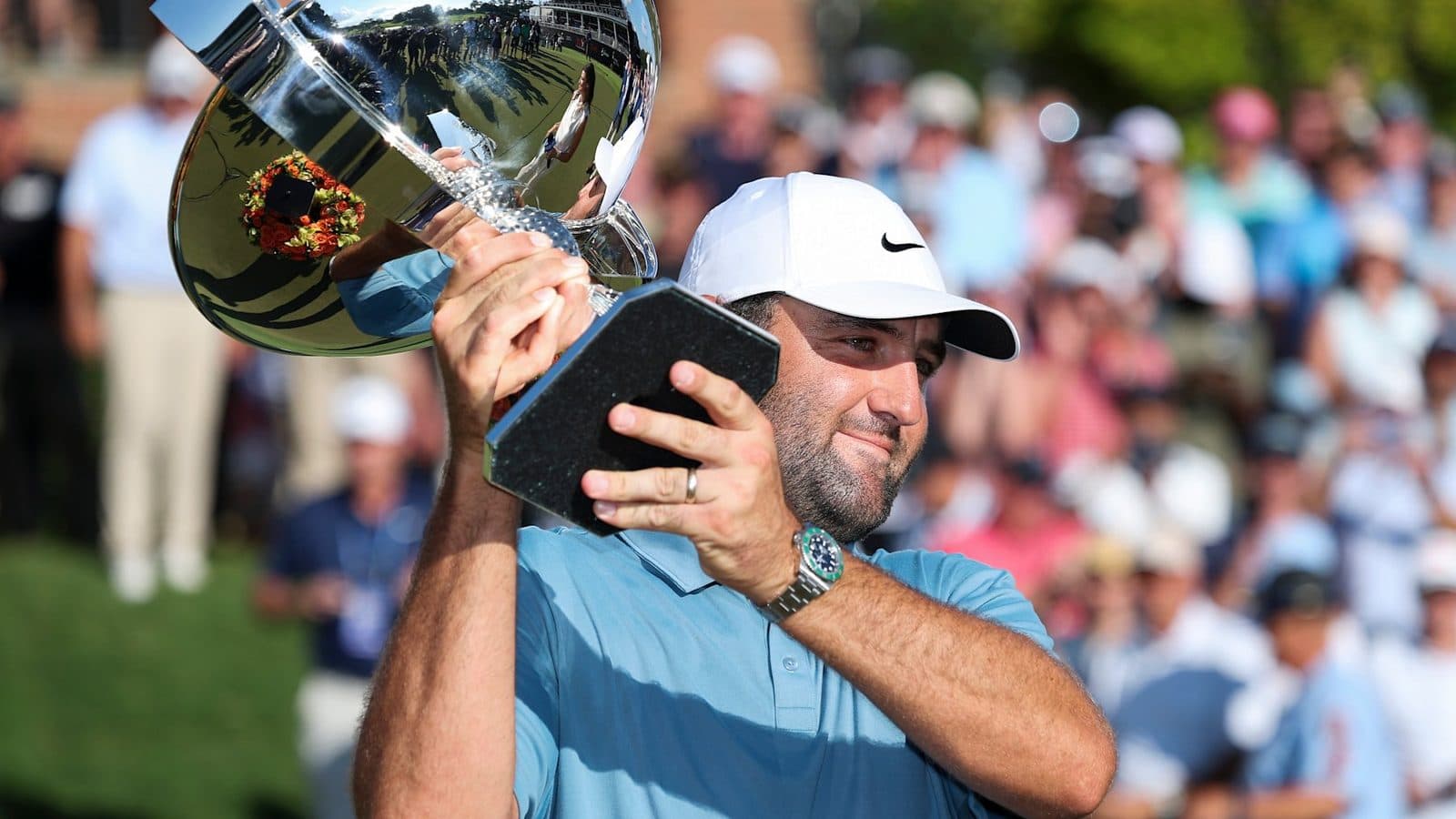
Thirty players. No cut. One winner takes home the FedEx Cup and the biggest check in professional golf. The TOUR Championship at East Lake is unlike anything else on the calendar — not just because of the stakes, but because of what the field structure does to the DFS and betting markets.

When you shrink a field to 30, the math changes everywhere. Ownership percentages that would feel totally normal in a full-field event become genuinely loaded in a tournament where a third of the entries might carry the same guy. Cash games tighten up because there's nowhere to hide. GPP construction becomes less about finding obscure names and more about identifying exactly which of the chalk is worth fading — and at what price.

The model ran the full 30-man field and came back with something interesting: there is real chalk worth playing, some chalk that is badly overpriced, a few DFS leverage plays that could genuinely break open a lineup, and a betting card that is concentrated but confident. We'll walk through all of it.

01 · WHAT MATTERS HERE

The course profile brief is sparse this week — East Lake is East Lake, a classic A.W. Tillinghast design that has hosted this event for decades and rewards a specific kind of player. What the model's course-fit grades do tell us is meaningful: it is rewarding clean ball-strikers who can manage their game over 72 holes, not just bombers who get hot for a weekend.

Look at the fit grades distributed across the field. The A-fits in the data — Rory McIlroy, Xander Schauffele, Viktor Hovland, Russell Henley, and Justin Rose — cluster around players who combine iron precision with the ability to score on demand. The B- and C-fits among the low-salary guys are the honest tell: the model thinks the bottom of this field has real exposure, which matters for GPP construction.

One structural note that affects every DFS decision this week: with no cut and 30 players, floor matters less than it usually does. Everyone finishes. The game is entirely about ceiling, fit, and leverage. Build accordingly.

02 · THE OWNERSHIP LANDSCAPE

Here is where a 30-man field shows its teeth. The chalk is heavy.

The chalk — projected ownership (model)
PlayerSalaryProjOwnLevFit
Xander Schauffele$10.0K98.732%3.1xA
Ludvig Aberg$9.7K92.332%2.9xB-
Collin Morikawa$8.1K91.030.3%3xB+
Chris Gotterup$7.9K87.828.5%3.1xB-
Matt Fitzpatrick$7.8K90.128%3.2xB
Si Woo Kim$7.7K89.226.7%3.3xB

Xander Schauffele and Ludvig Aberg are both projected at 32% ownership — that is not a DFS field, that is a coin flip on whether your neighbor in the lobby is playing the same guy. Collin Morikawa sits at 30.3%. At those levels, the leverage scores tell the real story: Schauffele is a 3.1, Aberg is 2.9, Morikawa is 3.0. You are paying full price for players who will not differentiate your lineup in any meaningful way if they perform as projected.

The question worth asking on every high-ownership player this week: is the chalk justified, or is it just familiarity? Aberg's B- fit grade at 32% ownership is the one number in that table that quietly demands attention. The market is pricing him like an A-fit. The model disagrees.

03 · CASH PLAYS

In cash, you want the highest projected floor at the most efficient salary — players the model trusts to finish near the top of a 30-man field regardless of whether things break perfectly. The core of the cash lineup is fairly clear.

Top projected — cash core (model)
PlayerSalaryProjOwnLevFit
Scottie Scheffler$14.0K112.613.1%8.6xB+
Rory McIlroy$11.0K99.813.1%7.6xA
Xander Schauffele$10.0K98.732%3.1xA
Patrick Cantlay$8.9K92.422.5%4.1xB+
Ludvig Aberg$9.7K92.332%2.9xB-
Tommy Fleetwood$9.0K91.823.1%4xB+

Scottie Scheffler leads the field at 112.6 projected with a ceiling of 145 — and here's the wrinkle most people overlook: he is only at 13.1% ownership despite being the best player in the world. That is a B+ course fit with the highest proj in the data and leverage at 8.6. In cash, you play Scheffler. Full stop.

At the value layer, the best-fit names are the quiet cash anchors. Viktor Hovland at $7,300 with an A fit and 88.8 projected is the most efficient salary-to-fit ratio in the data. Russell Henley at $7,500 carries the same A fit at 86.1 projected. These two are cash-game building blocks that most lineups will not carry at full weight — and that is exactly where you want to be.

Best course-fit value (model)
PlayerSalaryProjOwnLevFit
Viktor Hovland$7.3K88.821.3%4.2xA
Russell Henley$7.5K86.123.6%3.6xA
Justin Rose$6.9K81.316.6%4.9xA

Justin Rose at $6,900 with an A fit and 81.3 projected is the cheapest A-fit in the entire brief. For cash, he is a legitimate differentiator at the low end of the salary stack.

04 · GPP & LEVERAGE

GPP construction at the TOUR Championship is a study in restraint. With so much chalk bunched between 25% and 32%, the leverage plays do not need to be outlandish — they just need to be real players at ownership that does not kill you if they finish top-five.

Highest leverage (model)
PlayerSalaryProjOwnLevFit
Ryan Fox$6.0K72.25.5%13.1xC
Akshay Bhatia$6.1K74.75.8%12.9xC
Alex Fitzpatrick$6.2K76.66.1%12.6xB-
Alex Smalley$6.3K78.56.6%11.9xB-
Kristoffer Reitan$6.4K78.16.7%11.7xC
Scottie Scheffler$14.0K112.613.1%8.6xB+
Rory McIlroy$11.0K99.813.1%7.6xA
Adam Scott$6.5K82.414.5%5.7xB+

Scheffler and McIlroy surface again in the leverage table, and this is worth understanding: in a field this small, players projected near the top who happen to be at lower ownership than their ability warrants are legitimate GPP differentiators. Scheffler at 13.1% in a 30-man field is essentially a tournament-winner who half the lobby is fading. That is a gift.

Adam Scott at $6,500 with a B+ fit is worth a look in tournaments — 14.5% ownership, 114 ceiling, and the kind of East Lake history that the model tends to respect in course-fit grades. Gary Woodland at $6,600 also draws a B+ fit at 14.4% ownership. Neither is a flashy name, but that is the point.

The pure leverage plays — Ryan Fox, Akshay Bhatia, Alex Fitzpatrick, Alex Smalley, and Kristoffer Reitan — all carry C or B- fits and sub-7% ownership with leverage scores north of 11. The model is honest about the fit grades here: these are long shots, not projections. But in a large-field GPP, a few units of exposure to Reitan's 111.5 ceiling at 6.7% ownership is exactly the kind of tail risk that wins tournaments.

05 · THE PUNT-LEVERAGE TIER

Let's be direct about the punt tier: the model is not telling you these players are likely to win. It is telling you their ceilings are real and their ownership is low enough that if one of them goes off, you will have almost no lineup competition.

Ryan Fox at $6,000 is the cheapest salary in the leverage table and carries a ceiling of 100.5 — meaning if everything goes right, he finishes comfortably above the cash line. His C fit is a flag. His 13.1 leverage score means almost nobody is exposing themselves to him. One or two of these in your most aggressive GPP entries is the right move. All five of them in the same lineup is not a strategy, it is a prayer.

Akshay Bhatia is the most interesting name here — $6,100, 107 ceiling, 12.9 leverage. He is a genuinely talented player with real upside who just does not fit East Lake's profile the way the model wants. If you believe in him independently, the price and ownership make it easy to rationalize.

06 · TARGET SCORES

Before you submit a single lineup, know what you are building toward.

Target scores — 6-golfer DK roster
Cash line
464
Top 10%
528
Top 1%
577
Perfect lineup
672

Cash at 464, top-10 at 528, top-1 at 577, optimal at 672. The gap between cash and first place is 113 points — in a 30-man no-cut field, that is meaningful. You cannot grind your way to a GPP win here with a safe lineup. The gap between cash and the optimal ceiling (672) tells you there are massive points available at the top — which means the ceiling of your lineup matters enormously. Do not sacrifice 15 projected points chasing an extra leverage play that brings your ceiling down.

07 · THE BETTING CARD

The card this week is 54.5 units total across four plays, all in placement markets. Here is what we staked and why.

THE STAKED PLAYS

  • Robert MacIntyre — Top 20, +2200, 16u. This is the number that stops you cold. The model has MacIntyre finishing inside the top 20 in 65% of simulations. The book has him implied at 5.7%. That is a 59.3-percentage-point edge — the largest in the brief by a wide margin. At +2200, you are getting paid like he is a massive long shot in an event with 30 players. East Lake is a ball-striker's venue. MacIntyre is a ball-striker. Sixteen units is a significant commitment, and it reflects how clean this edge is.
  • Hideki Matsuyama — Top 20, +240, 16u. Model at 74.3%, book at 32.9%, edge of 41.3 percentage points. Matsuyama at +240 to finish top 20 in a 30-man field is a pricing anomaly. He has the game for East Lake and the book is giving you nearly 2.5-to-1 on a player the model considers a heavy favorite to crack the top 20. Sixteen units.
  • Xander Schauffele — Top 10, +500, 12.5u. Note the market: this is top 10, not top 20. The model has Schauffele finishing top 10 in 58.3% of simulations; the book implies 18.7%. Edge of 39.6 points. Getting +500 on a player at 58% in 10 spots out of 30 is not subtle. Twelve and a half units.
  • Patrick Cantlay — Top 10, +850, 10u. Same structure: model at 47%, book at 12.8%, 34.2-point edge. Cantlay is a measured, cerebral player who tends to show up in events where consistency beats explosion. Top 10 in a 30-man field at +850 when the model has him just under a coin flip is exactly the kind of price inefficiency we build a card around. Ten units.

LEANS — tracked on the board, no money behind them

Several other placement edges cleared the data without making the card. These are leans — worth knowing, not worth acting on as official plays this week.

  • Xander Schauffele top 20, -145 (model 87.1%, book 61.8%, +25.4pp edge) — the edge is real but the price is negative and the top 10 play already carries our Schauffele exposure.
  • Patrick Cantlay top 20, +100 (model 82.1%, book 51.8%, +30.3pp edge) — same story; the top 10 is the more interesting vehicle and we are already there.
  • Kristoffer Reitan top 20, +350 (model 54.6%, book 24.2%, +30.3pp edge) — this one did not clear the card threshold, but the edge is legitimate and he surfaces in the GPP leverage tier too. If you have independent conviction on Reitan, the number is fine.
  • Matsuyama top 20, +240 — already on the card; listed here for completeness in the placement edge table.
  • McIlroy top 20, -240 (model 87.9%, book 74.6%, +13.3pp edge) and Tommy Fleetwood top 20, -260 (model 82.4%, book 75.2%, +7.2pp edge) — both show model edges but the juice and narrow gap mean the expected value does not meet our bar. Leans at best.
08 · THE BOTTOM LINE

The TOUR Championship is the one event all year where the obvious plays are genuinely obvious — and that is precisely what makes the market beatable at the margins. Everyone knows Scheffler is the best player in the field. Everyone knows Schauffele, Morikawa, and Aberg are the chalk. The books know it too, and they price accordingly.

Where the model found its edges this week was in placement markets that the books undervalued — Robert MacIntyre at a 59-point model advantage, Hideki Matsuyama at 41 points, and two top-10 plays on Schauffele and Cantlay where the difference between what the model sees and what the book is offering is substantial. That is 54.5 units committed with a clear thesis on each.

In DFS, the framework is equally clear: Scheffler is the most underprice-adjusted play in the field relative to his ownership. The A-fit value tier — Hovland, Henley, Rose — is where your salary relief comes from without giving up course-fit quality. And the bottom of the leverage tier exists for GPP entries where you need someone at 6% with a real ceiling. Just do not convince yourself the C-fits are secretly A-fits because they have low ownership. The model already accounted for that, and it still gave them C grades.

Thirty players. One week. The card is built. Good luck out there.

Written by Arcline AnalyticsSee today's card →