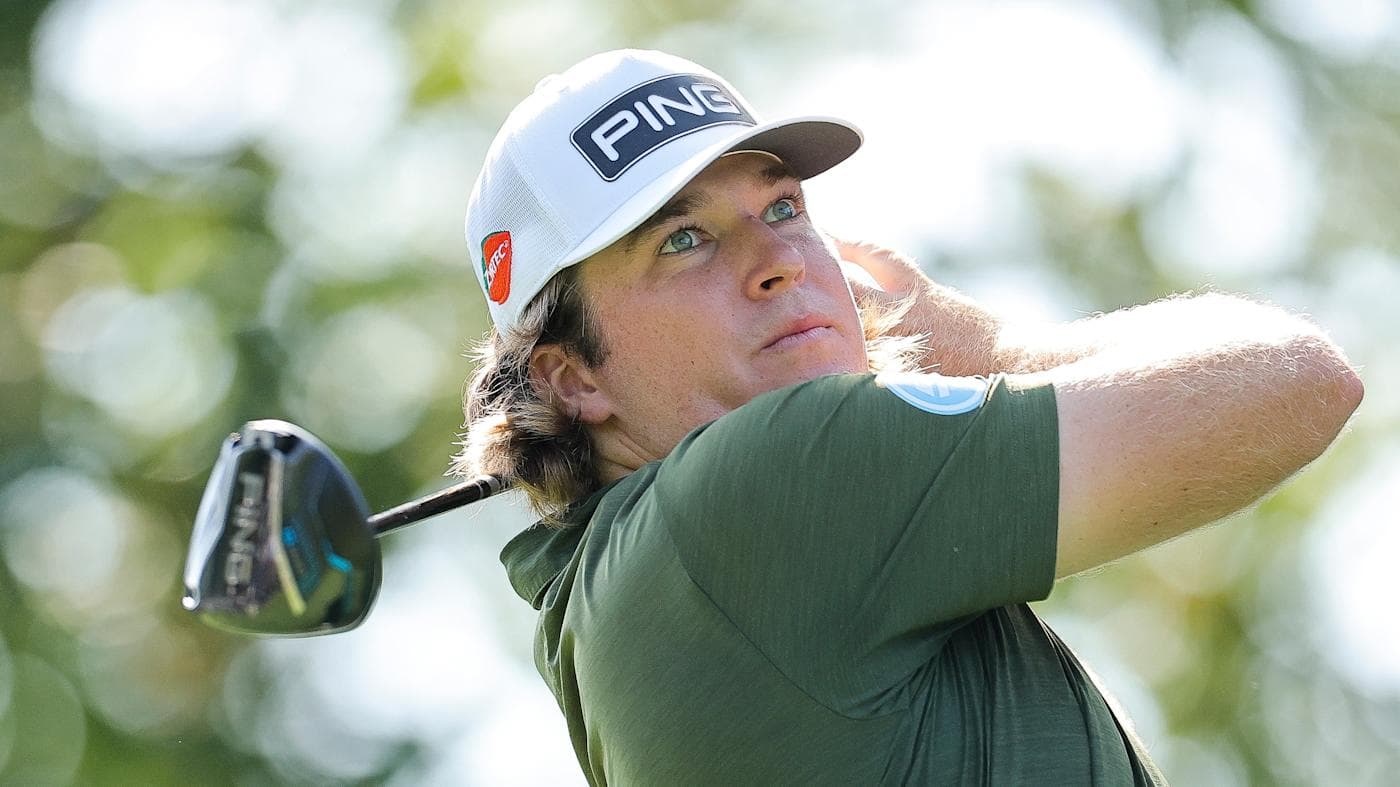
Jackson Shipley. Photo: PGA Tour. Credit only. Taken down on complaint..
COURSE PREVIEW
Koivun Is the Chalk, But the Edge Is Elsewhere
Jackson Koivun leads the Biltmore Championship field on every projection metric — and 31% of DFS lineups already know it. This week's real question is who sits just outside that spotlight and still earns an A-grade course fit.
By Arcline Analytics7 min read
OVERVIEW
The Biltmore Championship Asheville brings a 128-player field to The Cliffs at Walnut Cove in the North Carolina mountains — a private club layout that doesn't get the same scouting coverage as a PGA Tour venue, which makes course fit a more interesting variable than usual. The market is already sorting itself out in predictable ways: Jackson Koivun at the top of the board, a cluster of recognizable names filling out the middle tiers, and a longer tail of lower-owned players who carry legitimate upside at reduced salaries.
Nothing made the card this week — the outright and placement edges didn't clear the bar, so there are no official plays. What the model does produce is a clear picture of which players fit the course profile, where the projected-ownership distribution creates leverage opportunities, and what a winning lineup likely needs to look like. That's the focus here.
THE COURSE
The Cliffs at Walnut Cove is a Jack Nicklaus design set in the Blue Ridge foothills outside Asheville. Mountain course routing tends to mean elevation change, tighter corridors, and a premium on ball-striking precision over raw power — though the specific yardage and configuration for this week's setup aren't verified in our brief, so we're writing around that rather than inventing numbers.
What the course profile does tell us is that the model rewards a particular type of player here, and that signal is consistent across every tier of the field: every named player in the top-projected, high-leverage, best-fit-value, and chalk groups carries an A-grade course fit. That's notable. It suggests the model sees a clear skill signature for this track — not a week where fit grades are splitting the field — and the differentiation comes from price, ownership, and ceiling rather than who qualifies for the course in the first place.
The practical implication: course fit alone doesn't build a lineup this week. You need a view on price and projected ownership before the fit grade adds any information.
WHAT THE MODEL REWARDS
With a universal A-fit grade across the board, the model's differentiation this week comes through in projected scoring and ceiling rather than a filtered shortlist. The spread between the top projection (Koivun at 79.9) and the bottom of the high-leverage group (Taylor Pendrith at 60.0) is meaningful — nearly 20 points of projected fantasy scoring separates the field leader from a player available at $7,900.
The ceiling column is where things get interesting for tournament play. Corey Conners at $9,400 carries a 109.5 ceiling — higher than several players priced above him. Eric Cole at $9,100 shows a 108.0 ceiling despite ranking eighth in the projection column. Those ceiling-to-salary ratios matter in GPP construction, where the goal is building to the 556-point winner threshold or the 689-point optimal, not the 417-point cash line. The target scores are a useful reality check: the difference between cashing and finishing first is roughly 139 points, which is the distance between a solid week and a player catching fire.
THE WINNER'S PROFILE
The optimal projection sits at 689 points. The winner threshold is 556. Neither of those numbers gets built without at least one player reaching or approaching his ceiling — and the ceiling column shows that a handful of players in this field are capable of it. Koivun's 116 ceiling is the highest in the brief. Jacob Bridgeman at 112 and Conners at 109.5 are the next two. All three carry A-fit grades and are priced in the top tier.
The tension is ownership. Koivun projects to 31% — nearly one in three lineups will have him. Bridgeman sits at 19.3% and Conners at 23.5%. A lineup that wins a large-field GPP while rostering all three of the top chalk options needs every other piece to differentiate, which is a difficult construction puzzle. More commonly, the tournament winner either benefits from one chalk performing at ceiling alongside a few lower-owned contributors, or they took a deliberate step away from the most-rostered name at the top and were right about it.
The profile that fits this course and these numbers: a player who drives it well enough to handle mountain elevation and tight corridors, converts scoring opportunities efficiently, and doesn't leak shots on or around the greens. Beyond that, the winner will need a hot putting week — they always do at this level of competition.
NAMES THAT FIT
The value tier is where construction decisions get made this week, because the top of the board is heavily projected and heavily owned. The best-fit-value group offers eight players with A-grade course fit at salaries between $7,500 and $8,500 — a range that creates real lineup flexibility.
Best course-fit value (model)
Player
Salary
Proj
Own
Lev
Fit
Ryo Hisatsune
$8.5K
68.7
9.7%
7.1x
A
Marco Penge
$8.4K
66.2
22.2%
3x
A
Michael Kim
$7.8K
65.4
10%
6.5x
A
Jackson Suber
$8.2K
65.0
15.3%
4.2x
A
Andrew Novak
$7.8K
65.0
10.9%
6x
A
Ricky Castillo
$7.5K
64.3
6.3%
10.2x
A
Christiaan Bezuidenhout
$8.1K
64.3
10.9%
5.9x
A
Nick Taylor
$7.9K
64.0
10.2%
6.3x
A
Ryo Hisatsune leads the group at $8,500 with a 68.7 projection and a 104.5 ceiling — matching Marco Penge's ceiling at a $100 premium, but with ownership at 9.7% versus Penge's 22.2%. That ownership gap is the most straightforward leverage argument in the brief. Hisatsune also appears in the top-projected group, which speaks to how the model views his overall floor relative to salary.
Michael Kim ($7,800, 65.4 proj, 103.1 ceil, 10% own) and Andrew Novak ($7,800, 65.0 proj, 103.5 ceil, 10.9% own) are nearly identical twins in the data — similar salary, similar projection, similar ceiling, similar ownership. Either works as a lineup piece; the model doesn't differentiate them meaningfully. Ricky Castillo at $7,500 is the cheapest A-fit option in this group with a 100.6 ceiling and 6.3% ownership, which is the kind of number that creates genuine lineup separation in a 128-player field.
From the top-projected list, the two names worth highlighting for their leverage scores are Davis Thompson (7.2 leverage, $9,700, 9.9% own) and Rasmus Hojgaard (7.7 leverage, $9,800, 8.9% own). Both are priced near the top of the salary range but project well below Koivun and Bridgeman — the market hasn't chased them the way it has the leaders, which is where the leverage score comes from. Whether that gap is correct or an opportunity is the question the model flags without fully answering.
THE BOTTOM LINE
Nothing cleared the bar for an official play this week, so the card is empty and the leans are tracked on the board without money behind them. That's the honest position, and it's worth saying plainly rather than filling the space with manufactured conviction.
What the data does support is a clear construction framework. Koivun is the field's best projection and will be in nearly a third of lineups — fading him entirely in cash games is probably wrong, but building around him in GPPs requires the rest of the roster to do real work. The value tier has genuine options at A-fit grades between $7,500 and $8,500, with Hisatsune and Castillo as the two names carrying the most favorable ownership-to-ceiling ratios. Thompson and Hojgaard are the mid-salary names with the highest leverage scores among the top-projected group — lower owned than their projection suggests they should be.
The target scores frame the week: 417 to cash, 495 for a top-10, 556 to win. Building to the cash line is a conservative exercise in taking the field's best projections at manageable salaries. Building to 556 or 689 requires a ceiling event from at least one player — and the brief shows several A-fit options capable of delivering one.
This story reflects the information and prices available at the publication time shown above.